Kraken: A Ludum Dare 29 Postmortem

You are a deep sea explorer searching for treasure. As your craft descends into the murky depths large kraken will approach your ship. Fire your harpoons to kill them before they get close enough to attack your underwater vehicle. 

Press left or right to use your claw to capture treasure. Avoid hitting anchors which will damage your craft. 

Your deep sea adventure awaits!

Last weekend I created Kraken, a web game for the Ludum Dare 48 hour game development competition. “Beneath the surface” was the theme chosen for this competition and, coincidentally, the Atari 2600 ET landfill dig was also held the same weekend. I felt inspired to create Kraken as a retro Atari 2600 style game.

What Went Right

I kept the graphics simple. Creating a retro style game that could pass as an Atari 2600 cartridge meant blocky characters with few colors and limited animations. It also reduced the total number of screens to develop because many Atari 2600 games don’t have intro or game over sequences.

I sketched an outline of the game before I started development. Having a design in-hand reduced deadline stress because it gave me an idea of how long I could spend on each component. My design also held up, except for a pseudo-3d water effect I’ll mention later.

I finished on time. I think of the Ludum Dare 48 hour competition as an exercise in release management. It’s important for me to finish with something playable, and I’m proud I managed to do exactly that. I also had fun making the game and getting it out there.

What Went Wrong

I spent too much time on a pseudo-3d effect that didn’t work with the gameplay. I planned for the viewport to cycle colors around the edges as the player descended towards the kraken. The implementation was distracting and gave me a headache, so I transformed the feature into the shuttered pre-game and game over color changes.

I also didn’t prototype the graphics with the gameplay early enough. The squid were harder to draw than I expected, and ended up too small to look frightening as they approached the craft. Their small size also caused a disconnect with the harpoon collision detection. The final squid graphics didn’t take up enough space for the player to hit them directly.

Sound was planned but dropped. Atari 2600 game soundtracks are simple, but I hadn’t created sound for a web game before. I didn’t review the process before the competition started and I ran out of time during development.

Overall

I had fun creating Kraken. The Ludum Dare is a bit of a rush to get everything finished, and there’s always a moment of panic as the game comes together, sometimes unexpectedly. I’m glad I participated, and I’m looking forward to the next competition.

Play Kraken

Atari 2600 Landfill Dig Successful!

On Saturday, April 26, 2014, I watched folks live-tweet the excavation of Atari 2600 ET cartridges from a New Mexico landfill. A few hours after the dig began workers pulled up several cartridges complete with their packaging.

Atari 2600 ET Cartridge

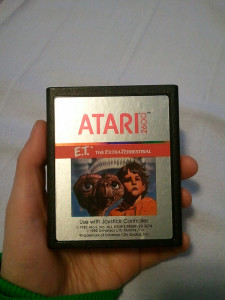
I’ve had this cartridge since I was five.

I played ET at home during the dig. I have the original cartridge (photo right), but I played using an emulator so I could post screenshots. I don’t remember finishing the game as a kid, but I beat it in an hour with the Stella emulator on the easiest setting.

Despite not finishing the game as a child, I think it says something that I saved the cartridge along with a handful of my other favorites through various moves over the years. It wasn’t until college that I learned the game had been a disaster for Atari and that the gameplay was considered poor and broken.

Overall, I think the game is okay. It’s possible the emulator made it easier to win, so I’ll have to try it again one day on a real Atari 2600. I’m glad I kept my copy, because the newly unearthed cartridges seem crushed and slightly melted.

May 2014 Reading List

In May I’m looking forward to reading the following books:

  • Ancillary Justice by Ann Leckie
  • Halting State by Charles Stross
  • A Song of Ice and Fire By George R.R. Martin (continued — I’m about 30% in right now)
  • The Drowning Girl by Caitlín R. Kiernan (continued — I had started this but never finished)

One of my goals is to read more novels this year. I think a loose commitment to read four books a month is probably a good pace.

Free GitHub Alternatives

I’ve decided to migrate my projects away from GitHub. A search for free Git alternatives produced the following:

  • BitBucket – Unlimited private repositories and free for up to 5 users. Also offers Mercurial.
  • GitLab – Unlimited private repositories and private collaborators.
  • Gitorious – Offers free public repositories.
  • Codeplex – Open source hosting for Git, Mercurial, or Team Foundation Server.

I’ve created a BitBucket account here and I’m looking forward to evaluating the service.  I’m also going to carefully review GitLab, though I don’t require more than five collaborators. I’m skipping Gitorious and Codeplex because I use private repositories.

I hope to use this migration to accomplish another goal: getting more of my free-floating code organized into repositories. This migration should be a good opportunity to do so.

Magento Developer Plus Certification Progress

I’m presently studying for the Magento Developer Plus certification. I hope to take the exam in early June and I’ve created a study plan to accomplish this.

First, I’m reading the excellent and free (with sign-up) Magento User Guide. I’m fairly new to Magento and knowing how the platform works as a shop owner and end-user is a good starting point before I map out and explore the source code.

I’ve also downloaded free The Magento Certified Developer Plus (pdf) official study guide, which is also offered here (with sign-up) along with other guides. I plan to read through it thoroughly after I’m finished with the user manual.

Finally, I found the free eBook “How to pass Magento Certification Exam in 30 days“. I’m undecided on reading it because my main goal of getting certified this year is to master the platforms I’m studying. I’m less interested in passing the test just for the sake of getting the certification.

I’m also thinking about taking Magento’s front-end certification towards the end of the year. I’m primarily focused on back-end systems, but the additional detail seems like it might be useful at some point.

Bundle Stars

Bundle StarsBundle Stars is my new humble bundle.

I used to love buying games from in-store bargain bin sales that supplied me with older and often unusual titles. This weekend I discovered Bundle Stars, a humble bundle-like distributor, only with more games that cost $4.99 or less per bundle.

I bought the Toxic, Extreme Sims 2, and Kalypso bundles which totaled to 30 games. I had originally planned to buy 4-5 of them, but now I have them all along with at least 15 others intriguing enough to try at least once. I was especially impressed with the farming and logistics simulators from the Extreme Sims 2 bundle because they are exactly the type of bargain-bin games I might have grabbed back in the 1990’s.

Bundle Stars games are distributed as Steam licenses, so there’s no physical packaging or manuals, but the documentation and related items are easy to find online. I’m excited to play all of these newly acquired games.

Week in Gaming 4/21/2014

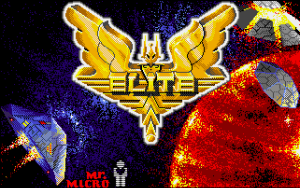
Elite 1 Title ScreenPlaying Elite 1 for the first time on my emulated Amiga 1200 was the highlight of this past week in gaming. I had fun reading the Elite 1 manual; it went on at length about pirates and offered tips that seemed funny out of context, ex. “Don’t trade expensive trivia to a hungry world.” I also fixed emulation display issues with the game and hope to post a configuration guide once I’ve put more time into testing it.
I chanced on two recent indie games: Quarries of Scred and the independently produced spin-off Quarries of Scred 1982. The first is a colorful futuristic mining exploration game that killed me quite a lot, the second is a text-based version that seemed to have more rogue-like elements (at least as far as text-based adventures go).

The Quarries of Scred games reminded me to play a variety of games in 2014. I’m going to spend this upcoming week working out a plan and possible schedule to make this happen.

Atari 2600 ET Landfill Dig

I am astonished that permission has been granted for a documentary crew to dig up potentially millions of unsold Atari 2600 ET game cartridges that were buried in a landfill in the early 1980’s. Despite a postponement last year for chemical testing, on April 26th filmmakers and the creator of the game will search a New Mexico landfill for the vintage cartridges.

I remember playing ET as a kid and getting stuck in pits quite a lot. I didn’t dislike the game, but it was so difficult there wasn’t much fun in finishing it back then. I also remember finding one piece of the telephone, which ET uses to call home, and it felt like a major victory at the time.

I won’t be in New Mexico on the 26th, but I might watch  some of the footage if they stream it. I’m also going to play the game again and see how well I can do as an adult.

Review: The Lurking Horror

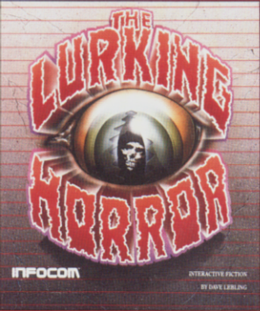
The Lurking HorrorThe Lurking Horror is an H. P. Lovecraft inspired text adventure game by Dave Lebling, the author of Zork. Published by Infocom in 1987, it’s a spooky text-based look at college life. This is a no-spoiler review of the Amiga version.

The game begins with the player confined to an almost eerily empty campus encased by a brutal snowstorm. After rushing to a computer lab to complete an assignment due the next day, you receive help from a frazzled computer expert who partially guides your actions.

The college campus is a fun space to explore and the puzzles are intuitively easy. The game comes with useful feelies that include a map and student id. Background music uplifts the story during action scenes.

Controls are immersive but frustrating. Early on I had to look through spoilers to determine how to interact with a microwave using terms the game could recognize. Navigation is also problematic. It’s not always obvious where entrances and exits are even after close examination of a room or area.

Despite the controls, I enjoyed the sparse characters that inhabited the creepy and desolate campus. Their movement patterns and behavior reminded me of Oblivion, sans graphics. I was even chased outside by one until I ended up in the snow (the character patiently waited for me to freeze to death at the campus entrance).

The Lurking Horror doesn’t include much lurking or horror, but I enjoyed the Amiga version of the game. The brief reminder of wandering around campus during my own college days more than made up for it.

Passed the Zend Framework v1 Certification Exam

On Saturday, April 12th, 2014, I passed the Zend Framework v1 certification exam. This is a legacy test sourced from version 1.5 of the Zend framework.

The Zend’s framework exam is a difficult test to study for because, despite its age (and unlike Zend’s PHP language certification), there isn’t as much study material available. I found Zend’s official study guide to be the most helpful along with reading through the 1.5 edition of the manual.

I used the following documents to study for the exam:

The Zend Framework is quite large and I went into the exam feeling like I could use an extra week of study. I also felt like a historian while reviewing the APIs of services from companies now out of business. Despite this legacy aspect, I’m appreciative that Zend is still offering this test and I’m happy to have taken it.

My next certification will be for Magento Developer Plus, an e-commerce platform that uses Zend Framework v1 for part of its core. I’m glad I invested my time into the framework exam because I believe it will help me learn Magento development more quickly.